 Georgetown Golf Cart Repair
 Golf Cart Battery Replacement in Georgetown & Sun City Texas
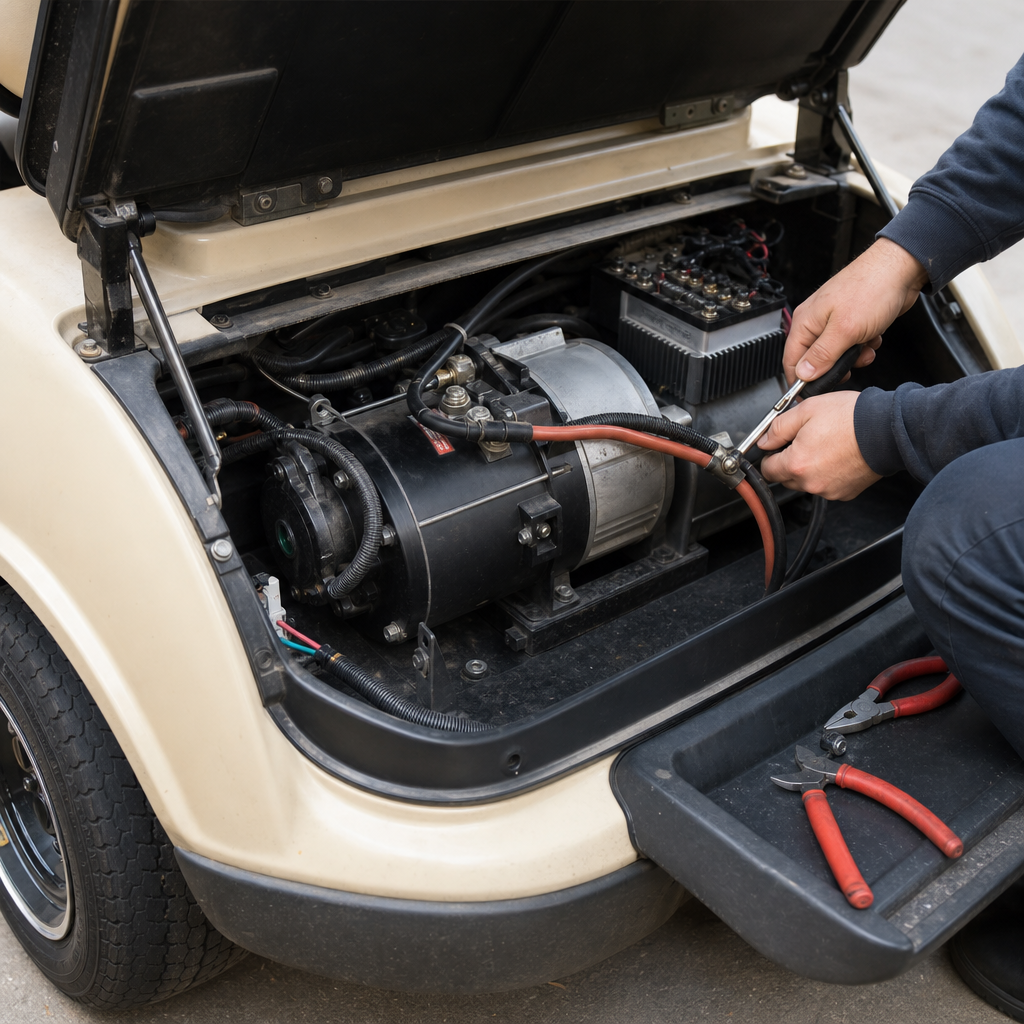
Golf cart battery replacement in Georgetown runs $1,200–$1,800 installed for a lead-acid pack (36V packs from about $1,200, premium 48V packs to $1,800) and $1,600–$3,500 for a lithium conversion, all done in your driveway with the old batteries hauled away. Before any of that, we load test the pack and test your charger, because a meaningful share of “I need new batteries” calls turn out to be a $100–$300 charger fix instead.
This is the highest-ticket, highest-stakes repair in golf cart ownership, and the one where an honest process matters most. Here’s the whole picture.
How batteries die in Williamson County
A flooded lead-acid pack is a consumable with a clock on it, and Central Texas runs that clock fast. Heat is the mechanism: high temperatures accelerate the chemical reactions inside each cell and evaporate the water out of the electrolyte. When the level drops below the tops of the lead plates, the exposed plate surface sulfates, a permanent capacity loss no charger can undo. Add the self-discharge that heat also speeds up, and you get the two classic Georgetown failure stories:
- The daily driver: a Sun City cart that runs to the course, the fitness center, and the shops every day, cycling the pack constantly. Around year four, range shrinks, charges take longer, and the cart sags on the Cowan Creek hills. The pack is simply spent.
- The summer sitter: a cart parked in June and ignored until October, common with residents who travel over the worst of the heat. It self-discharges for months in a hot garage, drops below the voltage the charger will engage at, and greets its owner stone dead. Sometimes recoverable with a controlled charge; often, deeply and permanently damaged.
Plan on 4–6 years for a maintained lead-acid pack here, less if watering slips. (Our post on battery life in Central Texas heat goes deep on the why and the warning signs.)
The test before the quote
No pack gets condemned on a guess. The on-site diagnostic (included in the $50–$100 service call, which is applied to the repair) runs:
- Per-battery load test. Resting voltage lies; voltage under load doesn’t. Six batteries can all read “fine” until you ask them for current. This also catches the one-bad-battery case, where a single failed unit is dragging five healthy ones: in a young pack, replacing just that one is sometimes the right call, and we’ll tell you so.
- Pack voltage across the whole string. Uneven cells and weak links show up here.
- Charger output test. A dead or weak charger mimics dying batteries. If the charger’s the fault, you get a charger repair quote, not a battery quote.
- Cable, terminal, and connection inspection. Corroded cables and cooked terminals cause voltage drop that feels exactly like weak batteries, and they’ll also murder a brand-new pack if left in place.
Only after all four do you get a number.
Lead-acid: what you’re buying
Most replacements here are like-for-like flooded lead-acid: six 6V batteries in a 36V cart (older Club Car DS and E-Z-GO models), or six 8V / four 12V in the 48V carts that dominate Sun City garages. The price band is mostly the battery grade, a premium pack (Trojan is the reference brand) costs more up front and survives Texas summers meaningfully better than a budget pack. We quote both tiers with straight lifespan expectations for each.
Every install includes: correct interconnect cable routing and replacement of any corroded cables (flagged before work starts), terminal cleaning and protection, hold-down check, initial water fill to the correct level, torque check, and a test drive. Then the 360+ pounds of old lead leaves on the technician’s truck for recycling, cores have value, and disposal is not your problem.
Lithium: the honest conversion math
If this is your second pack replacement, you should at least run the lithium numbers. The comparison for Central Texas:
| Lead-acid | Lithium | |
|---|---|---|
| Installed cost | $1,200–$1,800 | $1,600–$3,500 |
| Life here | ~4–6 years | 7–10+ years |
| Watering | Monthly in summer | Never |
| Weight | ~360–400 lbs | ~120 lbs |
| Charge time | Overnight | A few hours |
| Heat tolerance | Poor | Much better |
Entry 48V lithium (50–60Ah) at $1,600–$2,200 covers neighborhood-and-golf duty; 100Ah+ at $2,500–$3,800 gives daily-driver range. On cost-per-year the two chemistries are closer than the stickers suggest, so the decision usually comes down to lifestyle: lithium if you’re done watering batteries in a 100° garage, want faster charging and a lighter cart, and plan to keep it long-term. Lead-acid if budget rules, the cart’s future is uncertain, or the cart itself isn’t worth a $3,000 pack, and yes, we’ll tell you when it isn’t. Conversion is not an upsell script here; roughly as often, we talk someone out of it. The full comparison table lives on the pricing page.
Making the new pack last
The install ends with a two-minute owner briefing that adds years:
- Water monthly in summer, with distilled water, after charging: keep the plates covered, don’t overfill. This single habit is the difference between a 4-year and a 6-year pack. (Skip it entirely with lithium.)
- Charge after every use, not just when low, partial-state sitting sulfates lead-acid.
- Leaving for the summer? Full charge, full water, and ideally a maintenance charging setup. Storage prep is part of our tune-up service, and it’s built for exactly the Sun City travel-season pattern.
- Shade matters. A pack in an unshaded south-facing cart garage lives a measurably shorter life than one in a cooled garage.
At your home, anywhere in the service area
Battery day is a driveway job: we come to you in Georgetown, Sun City Texas, Leander, Cedar Park, and Round Rock, usually same-day or next-day in the Georgetown core. You don’t lift anything, and you don’t need to be home if the cart’s accessible and you’re reachable to approve the quote. It’s also the affordable way to do a 360-pound job, no trailer to rent, no haul fee, and the service call credited against the pack.
One honesty note, as always: we’re an independent service, not an authorized dealer for Club Car, E-Z-GO, Yamaha, ICON, or Evolution, if your batteries are new enough to be under a manufacturer or dealer warranty, that claim belongs with your selling dealer, and we’ll say so before you spend a dime with us.
Get a flat quote: send the brand, the pack voltage (printed on the charger or the batteries), and a photo of the battery bay if you can. We’ll come back with a real number, usually the same day.
Frequently Asked Questions
How much is a new set of golf cart batteries installed in Georgetown?
Lead-acid packs run $1,200–$1,800 installed at your home: 36V six-battery packs from about $1,200, 48V packs with premium brands like Trojan up to $1,800. Lithium conversions run $1,600–$3,500 depending on capacity. Every job includes cable and terminal checks and haul-away of the old batteries.
How do I know it's the batteries and not the charger?
You don't, until it's tested, which is why we load test each battery and test the charger's output before quoting a pack. Shrinking range and slow charging with a healthy charger points to batteries; a cart that won't take a charge at all is often a $100–$300 charger or port fix instead.
Can I replace just one bad battery instead of the whole pack?
Sometimes. If the pack is young (under ~2 years) and one battery failed, replacing it can be sensible. In an older pack, one new battery gets dragged down to its tired neighbors' level fast, you'd be burning money. The load test tells us which case you're in, and we'll say so honestly.
How long will a new pack last in this heat?
Realistically 4–6 years for maintained lead-acid in Central Texas, heat evaporates electrolyte and accelerates aging, so summer watering matters enormously. Lithium runs 7–10+ years with zero watering. Either way, we set you up with the habits (or the chemistry) that maximize it.
Do you take the old batteries?
Always, haul-away and recycling are included. A lead-acid pack is 360+ pounds of hazardous material; it leaves on the technician's truck, not in your trunk.
More golfcart services
- Mobile Golf Cart Repair: Fixed in Your Driveway, Georgetown TX
- Golf Cart Brake & Tire Service in Georgetown, Texas
- Golf Cart Motor, Controller & Solenoid Repair in Georgetown
- Golf Cart Charger Repair in Georgetown: Test First, Then Fix
- Golf Cart Tune-Up & Annual Service in Georgetown, Texas
- Golf Cart Speed & Controller Programming in Georgetown
- Golf Cart Lights & 12V Accessories in Georgetown
Areas we serve
- Georgetown, TX
- Golf Cart Repair in Sun City Texas: At Your Cart Garage
- Mobile Golf Cart Repair in Cedar Park, Texas
- Mobile Golf Cart Repair in Hutto, TX
- Mobile Golf Cart Repair in Jarrell, TX
- Mobile Golf Cart Repair in Leander, Texas
- Mobile Golf Cart Repair in Liberty Hill, TX
- Mobile Golf Cart Repair in North Austin
- Mobile Golf Cart Repair in Round Rock, Texas